
The Technology
Designed by Clinicians. Built for Better Decisions.
balanceback™ combines patented dual infrared goggle technology, proprietary software, and objective eye-movement analysis to support vestibular and neurological assessment.
Engineered for clinical efficiency, the system delivers reliable measurements, streamlined workflows, and a simplified hardware design with fewer components and connections.
Patented FDA-Cleared Trusted Since 2004
How it works
Objective Measurements You Can Trust
Every component of balanceback™ is designed around one goal: transforming eye movements into objective clinical evidence. From vestibular disorders to mTBI, Parkinson's disease, vestibular migraine, and other neurological conditions, balanceback™ helps clinicians evaluate patients with measurable data rather than observation alone.
-
Patented Dual Infrared Eye Tracking
Patented dual infrared technology captures precise horizontal, vertical, and torsional eye movements during vestibular and neurological assessment.
-
Patented Plug-and-Play Technology
The next-generation balanceback™ platform eliminates the traditional control box, reducing components, simplifying setup, and helping clinicians focus on patient care rather than system configuration.
-
Automatic Beat Detection & SPV
The software detects nystagmus beats and computes slow-phase velocity automatically — and you keep the clinical interpretation. Nothing is hidden behind a black box.
-
Clinician-Editable Nystagmus Editor
Review and refine every detected beat in the nystagmus editor. The analysis assists; the clinician stays in control of what counts.
-
Raw Trace Behind Every Number
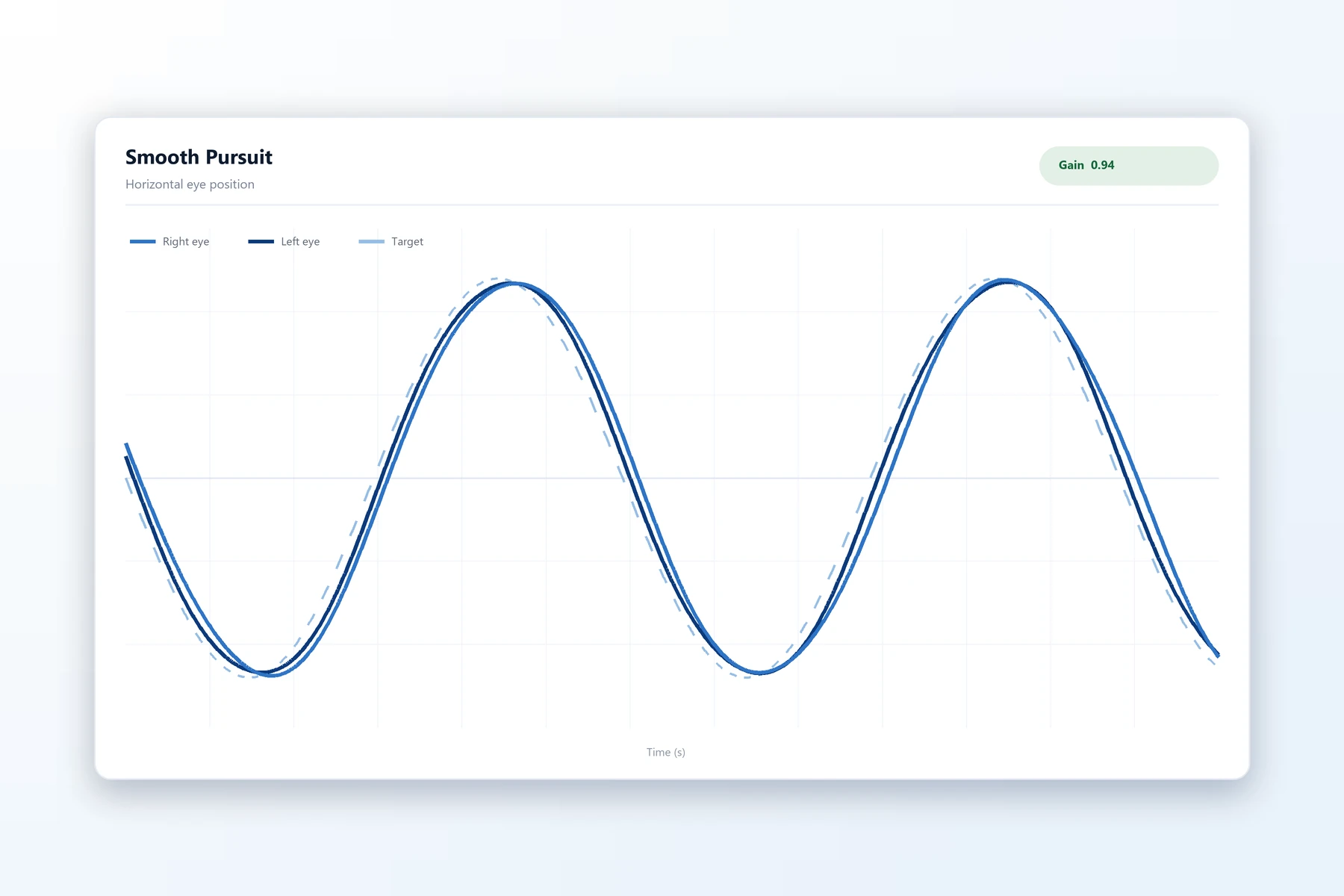
Access the raw eye-movement waveform at every timepoint. Every reported value traces back to the data it came from — the foundation of a defensible report.
-
Complete Vestibular & Neurological Assessment Platform
Supports evaluation of peripheral vestibular disorders and central nervous system conditions, including mTBI, Parkinson's disease, vestibular migraine, cerebellar disorders, and other CNS pathologies.
Security & integration
Ready for your IT and compliance teams
Security is engineered into the platform by design and mapped to the HIPAA Security Rule. We label what's architected in and what's on the roadmap — honestly.
-
Encryption at rest (AES-256-GCM)
By designPHI is encrypted at rest with AES-256-GCM authenticated encryption — each record bound to its own identity, so ciphertext can't be read or swapped.
-
Tamper-evident audit log
By designAn append-only, HMAC-SHA256 hash-chained audit log records every access and change; a broken chain is detected, not ignored.
-
Role-based access control
By designPer-clinic, role-based permissions enforced by one central policy decision point govern who can test, sign, and administer.
-
HL7 ORU & FHIR R4 reporting
On the roadmapStructured PDF reporting first; HL7 ORU and FHIR R4 DiagnosticReport export are on the integration roadmap.
-
SSO / OIDC
On the roadmapSingle sign-on via OIDC — and SAML for Azure AD — is on the roadmap for multi-site deployments.
FDA-Cleared Class II Nystagmograph · 510(k) K042529 & K070729 · Records, displays & analyzes eye movements — not a diagnosis
See the technology in action
Request a guided walkthrough of the dual-infrared tracking, the nystagmus editor, and the raw-trace report.